
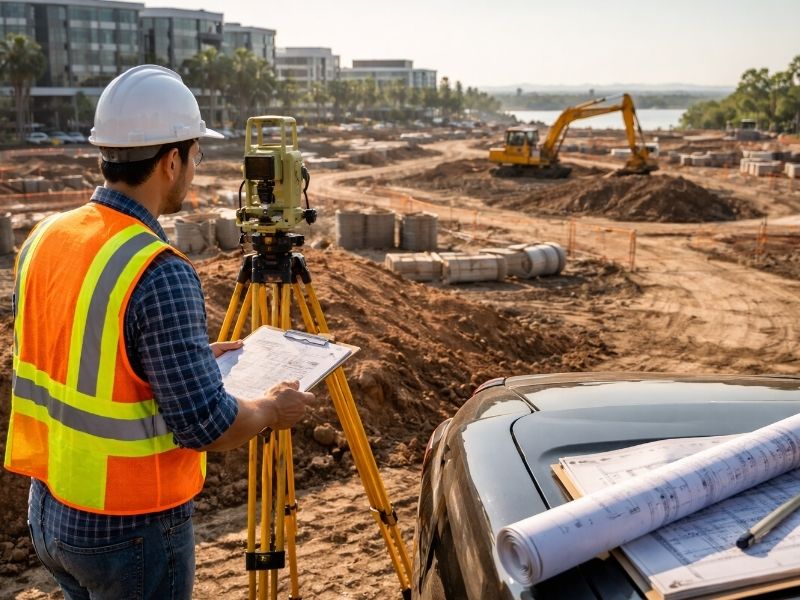
Most development projects don’t fail because of bad design or slow contractors. They stall because of bad survey mapping. A missed easement, a wrong boundary call, or an old base map can add weeks to a schedule and thousands to a budget before a single foundation is poured.
Survey mapping errors are common. They’re also preventable. Here’s what developers get wrong most often, and what it costs when those mistakes reach the field.
Ordering the Wrong Type of Survey for the Job
Not all surveys produce the same output. A lot survey and a topographic survey answer different questions. Ordering the wrong one wastes time and money, and it still leaves a gap in what your team needs.
Developers who skip the topographic survey and go straight into site design often find their grading plan doesn’t match the actual ground. The redesign costs more than the topo survey would have. On sloped or uneven sites, this mistake hits hard because every contour line affects where utilities go, where drainage flows, and where the building can sit.
Before ordering any survey, confirm with your engineer and architect which documents they need. Get that list in writing.
Using Outdated Survey Maps as the Base for Design
An old survey is not a current survey. A plat from ten years ago doesn’t show the fence a neighbor built six years ago, the widened driveway, or the rerouted utility line.
Developers who pull an old survey from the title file and hand it to their design team are taking a real risk. If conditions on the ground have changed, the design is built on wrong information. That problem shows up during construction, not during design. By then, fixing it costs far more.
If a survey is more than a few years old, or if anything has changed on the property or nearby parcels since it was done, order a new one. The cost is small compared to a mid-project correction.
When Lenders Flag Survey Age
Lenders and title companies have their own rules on how old a survey can be. Many won’t accept one older than six months to a year. If you’re working toward a construction loan, confirm the acceptable date range early. Finding out at closing that your survey is too old is a delay that didn’t need to happen.
Skipping the Records Research Phase
Survey mapping starts in the office, not in the field. A surveyor who goes straight to the site without pulling deed records, prior surveys, and recorded easements is doing partial work.
Records research finds problems a field visit can’t see. An access easement recorded in 1987 leaves no mark on the ground. A gap in the chain of title has no visible sign at the property corner. These issues only come out when someone looks for them in the public record.
Developers who push surveyors to skip deep research to save time often pay more later. A title issue that surfaces after closing becomes the developer’s problem to fix, and that fix is slow and expensive.
Survey Mapping Errors in Boundary Placement
Wrong boundary placement is the most costly survey mapping mistake on active construction projects. If a boundary line is off by even a few feet, structures end up in the wrong place, setbacks get violated, and neighboring parcels get affected.
This error is more common on sites where original survey monuments are missing or damaged. When a surveyor can’t find original markers, they have to rebuild the boundary from record documents and nearby evidence. That takes experience and careful work. Rushed jobs on tight deadlines produce poor results.
What Happens When a Boundary Is Wrong
A building placed over a property line or inside a neighbor’s setback doesn’t stay there. The municipality can require removal. The adjacent owner can take legal action. Title insurance may not cover the full cost if the survey that caused the problem was done improperly.
Fixing a boundary error after construction starts costs far more than getting it right before any digging begins. Require your surveyor to locate or set physical monuments at every corner before design work starts.
Not Verifying Easement Locations Before Site Design
Easements limit what you can build and where. A developer who doesn’t know exactly where an easement falls on a parcel before designing a building footprint will likely need to redesign after the survey maps it.
Utility easements, drainage easements, and access easements all remove buildable area. Some are narrow and easy to work around. Others cut through the most useful part of a lot. The design team needs that information at the start, not after a permit gets rejected.
Ask your surveyor to locate and map all recorded easements as part of the survey scope. Don’t rely on a deed reference alone. A deed may list an easement by book and page number without showing where it physically sits on your lot.
Treating Survey Mapping as a One-Time Step
Survey mapping is not just a pre-construction task. Some projects need updated surveys at more than one stage: before design, before permit submission, after rough grading, and after construction is complete.
An as-built survey at the end of a project shows what was actually built versus what was planned. Municipalities and lenders often require it before issuing a certificate of occupancy or releasing final loan funds. Developers who don’t plan for this step early are sometimes surprised by it at the worst possible time.
Build survey requirements into your project schedule from the start. Talk to your surveyor at the beginning about every survey document the job will need from start to finish.
Frequently Asked Questions
What is the most common survey mapping mistake on development projects?
Using an outdated survey as the base for site design is the most common and costly mistake. Conditions on the ground change over time. A survey that doesn’t reflect current conditions will produce a design that doesn’t match reality in the field. Ordering a new survey at the start of every project prevents this.
How do survey mapping errors affect construction loans?
Lenders require current, accurate surveys before funding. If survey errors come up during the lender’s review, the loan can be delayed. Boundary problems, missing easement disclosures, or surveys that don’t meet current standards can all trigger extra requirements that slow the closing process.
Can a developer be held liable for a survey mapping error?
A developer who builds based on a survey they knew was outdated or incomplete takes on real liability. If that survey leads to an encroachment, setback violation, or title defect, the developer may face legal claims from adjacent owners, lenders, or the municipality. Always use a current, properly sealed survey from a licensed professional.
How does skipping records research affect a survey?
Records research is how a surveyor finds easements, title gaps, and recorded restrictions that have no physical sign on the ground. A survey done without thorough records research is incomplete. These issues don’t disappear when they’re missed. They show up during permit review or title search.
When should a developer order an as-built survey?
Order an as-built survey after construction is complete but before the final inspection. Most municipalities and lenders require it as part of project closeout. Planning for it at the start of the project, rather than treating it as a surprise at the end, keeps the schedule on track.