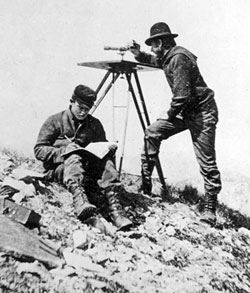
A topographic survey measures the shape and elevation of a piece of land. It records how the ground rises and falls, where the low spots are, and what physical features sit on the property. The result is a contour map that engineers, architects and developers use to plan construction and drainage before any work begins.
What the Survey Actually Records
When a surveyor runs a topographic survey, they collect two types of data: elevation readings and surface features.
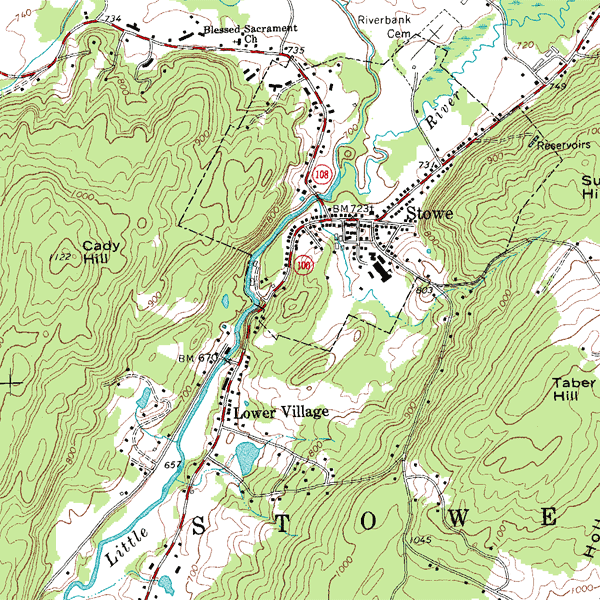
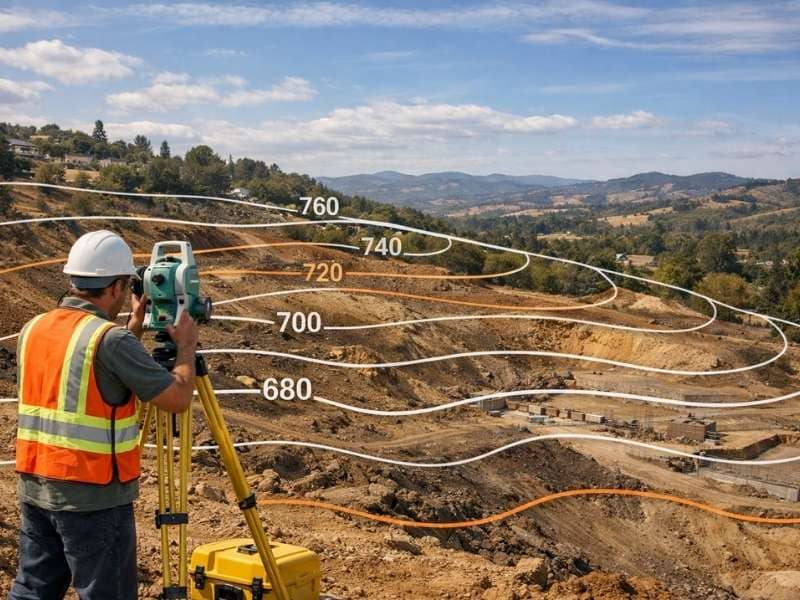
Elevation readings get assigned to hundreds or thousands of points across the site. Those points connect to form contour lines on the finished map. Contour lines show equal elevation, so when the lines are packed close together, the terrain drops or rises steeply. When they spread apart, the ground is flat or gently sloped.
Surface features are recorded alongside the elevation data. Trees, buildings, driveways, fences, drainage ditches, utility poles and retaining walls all get noted on the map. So what you receive at the end isn’t just a picture of the terrain. It’s a complete record of what’s on the land and how the ground behaves underneath it.
According to the National Map Accuracy Standards, vertical accuracy on a topographic map requires that no more than 10% of tested elevations exceed half the contour interval in error. For most residential projects, surveyors work to a 1-foot or 2-foot contour interval.
When You Need One
A topographic survey is required whenever a project depends on knowing how water moves, where the ground rises and falls, or whether a site meets elevation requirements for a permit.
Common situations include:
- New construction on undeveloped land
- Site plan approval from a local municipality
- Drainage or grading redesign
- Retaining wall design
- Subdivision of raw land for development
- Flood zone analysis tied to base flood elevation
Homebuilders, civil engineers and landscape architects are the primary users. Many local governments also require a topo survey as part of a building permit package, particularly on sloped or low-lying properties.
How Surveyors Collect the Data
The method depends on the size of the property and how much detail the project requires.
For standard residential lots, a field crew walks the site with GPS equipment or a total station. They record elevation points across the entire area. The more complex the terrain, the more points they collect.
For larger properties, drone surveys are faster. A drone flies a grid pattern over the land and captures either photogrammetric imagery or LiDAR data. LiDAR stands for Light Detection and Ranging. It fires laser pulses at the ground and measures how long they take to return, building a dense cloud of elevation readings across the site.
Modern GPS equipment used in surveying achieves accuracy within 1 to 2 centimeters. Drone-based surveys cost 30 to 50% less than traditional ground methods for properties over 2 acres, which makes them the practical choice for larger parcels and commercial sites.
Both methods produce accurate results. The right choice comes down to budget, acreage and what the project requires.
What the Finished Map Includes
The deliverable is usually a CAD file or PDF. It shows the property boundary, labeled contour lines, spot elevations at key locations and all the physical features the crew recorded.
Spot elevations are exact elevation readings at a specific point. They appear at driveways, building corners, drainage inlets and low areas of the yard. These give designers the fixed reference points they need to calculate cut and fill volumes, model how water drains or confirm that a planned floor elevation clears the base flood elevation on file.
The contour interval is agreed on before the survey starts. Residential projects typically use a 1-foot or 2-foot interval. Engineering-grade surveys for detailed construction plans may require a 0.5-foot interval.
Engineers and architects import the finished file directly into their design software. Every number on the map feeds into their calculations, so the accuracy of the survey affects every decision they make downstream.
How Much It Costs
Cost depends on three factors: property size, terrain complexity and the contour interval required.
A small flat lot costs less than a large wooded site with steep grade changes. According to Angi’s 2026 data, residential topographic surveys typically range from $500 to $6,500. Simpler lots under one acre often fall between $500 and $1,500. Larger or more complex sites push higher, sometimes into the several-thousand-dollar range.
Getting both a topographic and boundary survey from the same crew in the same site visit keeps costs lower. The coordinate systems stay consistent, and the surveyor only has to mobilize once.
Frequently Asked Questions
What is the difference between a topographic survey and a boundary survey?
A boundary survey locates property lines. A topographic survey maps the elevation and terrain within those lines. They answer different questions. Many construction projects need both, and surveyors often combine them into a single visit.
Do I need a topographic survey to get a building permit?
Many municipalities require one, especially for new construction on sloped land or in areas with drainage concerns. Check with your local building department before submitting a permit application to confirm what they require.
What is a contour interval?
A contour interval is the vertical distance between adjacent contour lines on a topo map. A 1-foot interval means each line represents a 1-foot change in elevation. Tighter intervals give more detail but require denser data collection and cost more.
Can a topographic survey be used for flood zone purposes?
Yes. The elevation data from a topo survey feeds directly into flood zone analysis, base flood elevation determinations and FEMA-related documentation. It’s often ordered alongside an elevation certificate on properties in or near a designated flood zone.